How to Size and Select a Solar Manifold Collector System for Commercial Hot Water Projects
How to Size and Select a Solar Manifold Collector System for Commercial Hot Water Projects
For commercial solar thermal projects, selecting the right collector type and sizing the system correctly are the two most critical factors that determine whether a project succeeds technically and financially. Hotels, hospitals, schools, residential complexes, and industrial facilities all have very different load profiles, operating schedules, and reliability requirements. A system that is oversized can waste capital and cause stagnation risks, while a system that is undersized may fail to meet demand and damage user confidence.
This article explains how to properly size and select a solar manifold collector system, with a focus on evacuated tube manifold technology, commercial hot water demand analysis, system integration, performance expectations, and return on investment.
1. Understanding the Hot Water Load Profile
The starting point for any commercial solar hot water project is an accurate understanding of the building’s hot water demand. This includes daily consumption volume, peak demand periods, seasonal variation, and temperature requirements.
Daily hot water volume (liters per day)
Peak demand hours (morning, evening, or continuous)
Required delivery temperature
Cold water inlet temperature by season
Occupancy rate and usage behavior
Hotels typically show sharp morning and evening peaks, while hospitals and dormitories may show more constant demand throughout the day. Industrial facilities may have process-driven loads with specific temperature requirements.
2. Translating Demand into Thermal Energy Requirements
Once the hot water volume is known, it can be converted into thermal energy demand using basic thermodynamic relationships. This allows engineers to estimate how much solar energy the system must supply on an annual and daily basis.
Solar contribution is usually designed to cover a percentage of the total annual demand rather than 100%, allowing auxiliary heating systems to handle peak loads and extreme weather conditions.
3. Choosing Between Collector Technologies
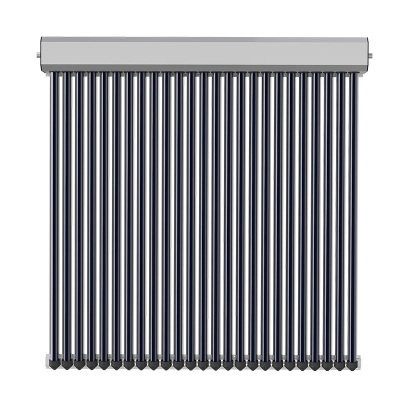
While flat-plate collectors and evacuated tube collectors are both widely used, evacuated tube manifold collectors are often preferred for commercial projects due to their higher efficiency under low ambient temperatures and better performance during winter and shoulder seasons.
The manifold architecture also simplifies hydraulic integration and maintenance, making it more suitable for large systems.
4. Determining Collector Field Size
The collector field size is determined by combining load analysis, climate data, collector efficiency, and available installation area. Key factors include:
Local solar irradiation (kWh/m²/year)
Collector efficiency curve
System losses (piping, heat exchangers, storage)
Roof or ground area availability
The result is a target collector area that balances investment cost and energy yield.
5. Storage Tank Sizing and Thermal Buffering
Storage tanks decouple energy collection from energy use. Proper tank sizing is essential to avoid energy waste and ensure stable hot water supply.
Typical commercial systems use between 50 and 100 liters of storage per square meter of collector area, depending on usage patterns and system design.
6. Hydraulic Design and Flow Control
Uniform flow distribution across the manifold collector field ensures that all collectors operate at similar temperatures and efficiencies. This requires proper pipe sizing, balancing valves, and pump selection.
7. Integration with Auxiliary Heating Systems
Solar systems rarely operate alone. They are typically integrated with gas boilers, electric heaters, or heat pumps that provide backup during periods of low solar availability.
Control logic determines when solar heat is used and when auxiliary systems are activated.
8. Economic Evaluation and Return on Investment
Economic evaluation includes capital cost, operating cost savings, maintenance costs, and system lifetime. Payback periods for commercial solar hot water systems typically range from 4 to 8 years, depending on energy prices, climate, and system utilization.
9. Risk Management and System Reliability
Risk management includes avoiding stagnation, freezing, corrosion, and scaling. Proper design, material selection, and monitoring reduce long-term risk and improve system reliability.
Conclusion
Correct sizing and selection of a solar manifold collector system is not a simple formula-based exercise. It requires a structured analysis of load profiles, climate conditions, system integration, and financial objectives.
For commercial and institutional projects, evacuated tube manifold systems offer a strong balance of efficiency, reliability, and scalability. When properly designed, they provide long-term energy savings, stable operation, and measurable environmental benefits.